


The breakfast aisle is filled with granolas marketed as "natural," "wholesome," or "healthy," but when you flip the package over, you'll often find sugar content that rivals dessert. The truth is, not all granola is created equal, and understanding how to spot the lowest sugar granola option can make a real difference in your morning routine and overall health.
In this guide, I'll share my professional criteria for evaluating granola, teach you my exact label-reading strategy, and recommend specific brands I've vetted (available in the UK, Ireland, Australia, and the US).
Whether you're managing blood sugar, trying to reduce added sugar intake, or simply want a more balanced breakfast, this guide will help you make informed choices without the overwhelm.
Now, I’m not anti-sugar. I’m anti misleading marketing. I see it constantly in my online nutrition clinic. People genuinely trying to improve their health, choosing foods labelled as “healthy,” “natural,” or “refined sugar free,” and then feeling confused and disheartened when their weight, energy, or blood markers are not moving in the direction they hoped. The problem is not effort. It’s that many foods are positioned as health foods when, nutritionally, they are not. And that disconnect leaves people feeling like they are doing something wrong, when in reality they were simply misled.
Jump to:
- Why Sugar Content Matters in Your Granola
- A Dietitian's Complete Granola Checklist
- My Label-Reading Strategy: What To Do in the Granola Aisle
- The Lowest Sugar Granola Brands I Recommend
- How to Eat Low-Sugar Granola
- When Homemade Makes Sense (And My Recipe)
- What About "No Added Sugar" Claims?
- FAQS About Low-Sugar Granola
- Other Healthy Breakfast Ideas
- The Bottom Line
- 💬 Comments
Why Sugar Content Matters in Your Granola
When it comes to sugar, most of us are already consuming far more than we realize.
In the UK, adults are advised to keep free sugars below 30g per day (about 7 sugar cubes), yet average intakes are often well above this. In the US, the new dietary guidelines state that no amount of added sugars is recommended and that one meal should contain no more than 10 grams of added sugars (2.5 sugar cubes). Yet despite these recommendations, adults in the US consume on average around 17 teaspoons of added sugar per day, far exceeding what is considered supportive of long-term health.
So when a “healthy” breakfast granola contains 10 to 12g of added sugar, you are already using a large portion of that target before the day has even started. This is why I care less about demonizing sugar, and far more about helping people clearly understand what they are actually eating, so they can make informed, confident choices without feeling misled or discouraged.
Here's what happens when you start your day with high-sugar granola:
Blood Sugar Rollercoaster: High sugar content causes rapid blood glucose spikes followed by crashes, leaving you hungry and tired by mid-morning. This triggers cravings for more sugar, perpetuating a cycle that's hard to break.
Energy Depletion: While you might feel an initial energy boost, the subsequent crash makes it difficult to focus and be productive.
Long-Term Health Impact: Consistently high added sugar intake is linked to increased risk of type 2 diabetes, cardiovascular disease, and weight gain. The occasional high-sugar breakfast isn't the issue, it's the daily habit that accumulates over time.
Hidden Calories: Sugar-heavy granolas pack calories without much satiety. You might pour yourself a bowl thinking it's healthy, only to find yourself reaching for snacks an hour later because the protein and fiber content is too low to keep you satisfied.
The good news? Finding lower-sugar options doesn't mean sacrificing taste or satisfaction. It just requires knowing what to look for.
A Dietitian's Complete Granola Checklist
After years of reviewing products and working with clients, I've developed a comprehensive checklist that goes beyond just sugar content. Here's exactly what I look for when evaluating granola:
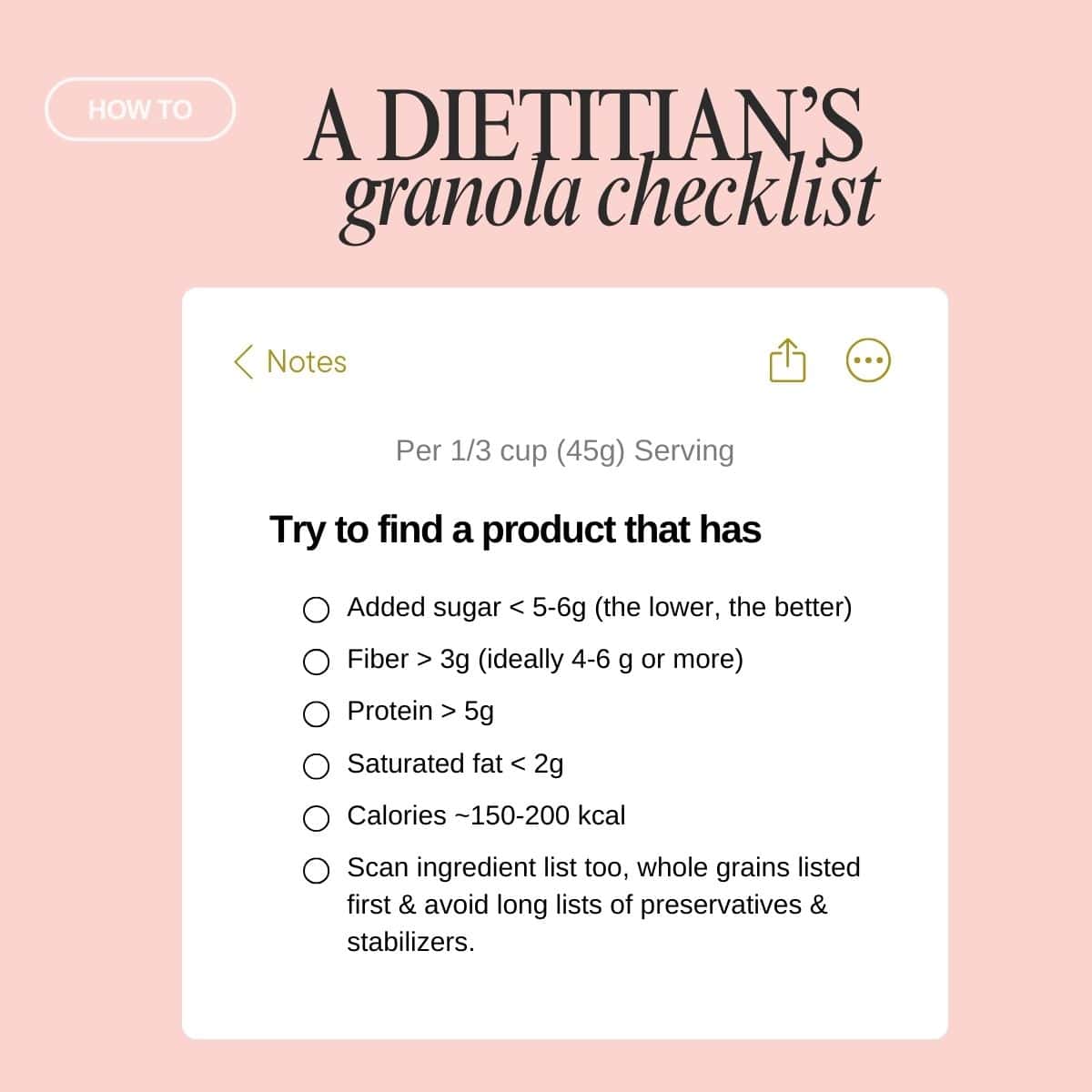
Per ~⅓ Cup (45g) Serving:
Added Sugar: ≤ 5-6g (the lower, the better)
- 0-3g = Exceptional choice
- 4-5g = Excellent option
- 6-8g = Good choice
- 9g+ = Reconsider or use sparingly as a topping
Fiber: ≥ 3g (ideally 4-6g or more) Fiber is crucial for blood sugar management and satiety. It slows the absorption of sugar and helps you feel satisfied longer. Granolas with nuts, seeds, and whole oats naturally provide more fiber.
Protein: ≥ 5g Protein is your secret weapon against mid-morning hunger. Look for granolas that include nuts, seeds, or added protein sources. This keeps you fuller longer and prevents energy crashes.
Fat Quality: Aim for granolas where most of the fat comes from nuts and seeds, and keep saturated fat under 2g per serving. The best options use whole food sources like almonds, walnuts, and seeds, rather than relying heavily on coconut oil or palm oil.
Calories: Around 150-200 kcal This ensures you're getting a reasonable portion that fits into a balanced breakfast without going overboard.
Ingredient Quality Matters Too
Beyond the numbers, scan the ingredient list for:
- Whole grains listed first (oats, quinoa, buckwheat)
- Recognizable sweeteners in small amounts (honey, maple syrup, dates)
- Real nuts and seeds, not just flavoring
- Minimal additives - avoid long lists of preservatives and stabilizers
- No "natural flavors" (often a code for processed additives)
My Label-Reading Strategy: What To Do in the Granola Aisle
Here's my exact process when I'm standing in front of dozens of granola options:
Step 1: Check the Serving Size First
Before you look at ANY numbers, check the serving size. Some brands list ¼ cup (30g) while others list ⅓ cup (~40-45g) or even ½ cup (50g). This makes comparison nearly impossible unless you standardize.
My trick: Mentally standardize everything to ⅓ cup (45g). If a brand lists ¼ cup with 4g sugar, that's actually 5.3g per ⅓ cup. Don't let small serving sizes fool you into thinking the sugar content is lower than it really is.
Step 2: Find the Added Sugar Line
On UK labels, look for "of which sugars" under carbohydrates. On US labels, there's usually a separate "Added Sugars" line. This is your most important number.
What to ignore: "Total sugars" includes natural sugars from dried fruit and nuts. While total sugars matter, added sugars are what you want to minimize.
Step 3: Evaluate Protein and Fiber Together
These two work as a team to keep you satisfied. I look for granolas where protein + fiber together equal at least 8g. This combination slows digestion and stabilizes blood sugar.
Example: 5g protein + 4g fiber = 9g total ✓
Example: 3g protein + 2g fiber = 5g total ✗
Step 4: Scan the Ingredient List
Read the first 5 ingredients. If you see multiple forms of sugar (honey, maple syrup, brown sugar, cane sugar, date paste), that's sugar stacking which is a trick to make each individual sugar appear lower on the list.
Sometimes sugar is also named in a way that we may not recognise. To help identify sources of added sugars, look for ingredients that include the word
“sugar” or “syrup” or end in “-ose.”
Common added sugars that may appear on ingredient labels include
high-fructose corn syrup, agave syrup, corn syrup, rice syrup, fructose, glucose,
dextrose, sucrose, cane sugar, beet sugar, turbinado sugar, maltose, lactose, fruit
juice concentrate, honey, and molasses.
Step 5: Calculate Cost Per Serving
Divide the price by the number of servings in the package. Some premium granolas are worth it if they truly meet all criteria. Others are overpriced for what you're getting.
Save This Recipe! 💌
The Lowest Sugar Granola Brands I Recommend
Based on my criteria, here are the brands I've personally vetted and recommend to clients. I've organized them by budget and availability to make shopping easier for you.
Nutrition info is calculated per 40g or ⅓ cup serving.
Budget-Friendly Winners
These options meet my nutritional criteria without premium pricing - proof that eating well doesn't require a massive budget.

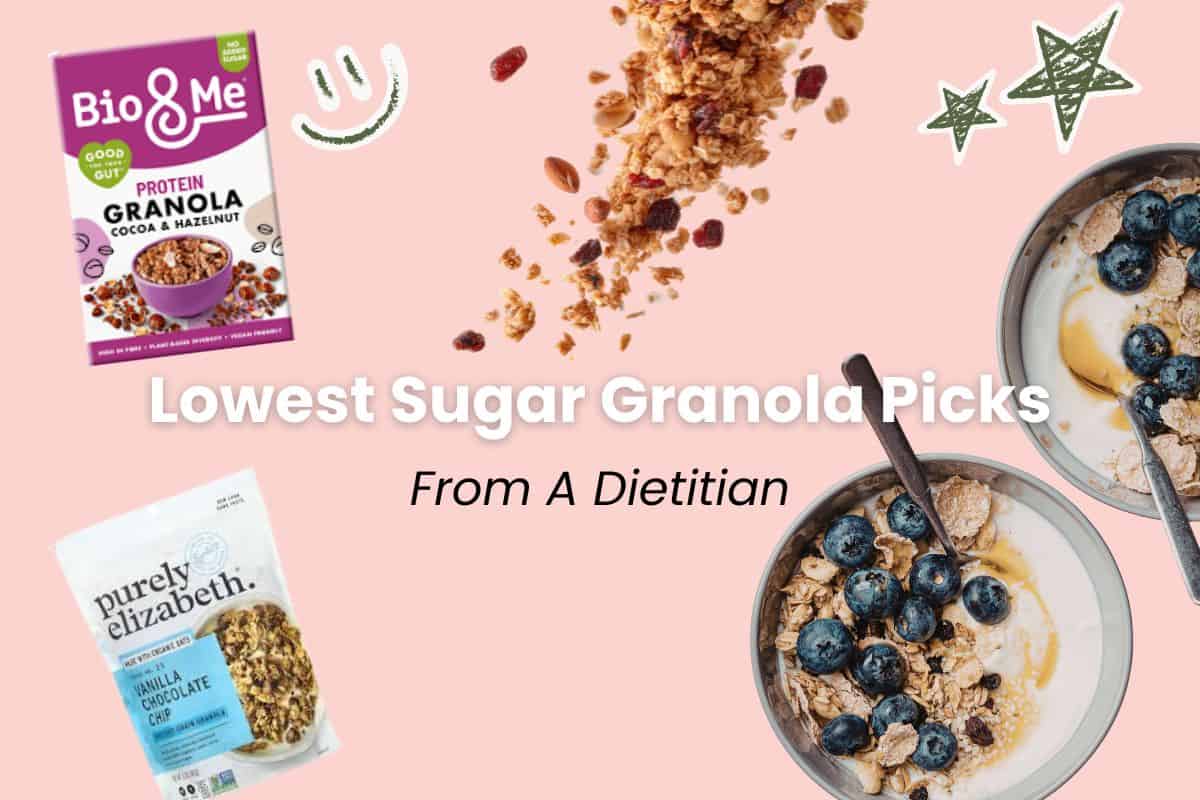
Bio & Me
- Sugar: ~2g per serving (from dates)
- Protein: 5.4g
- Fiber: 7g
- Calories: ~180
Where to find: Irish & UK supermarkets, Amazon.co.uk, Bermuda, Waitrose, Ocado
Why I recommend it: Uses extra virgin olive oil, contains no added sugar, instead using dates for sweetness.
Best for: Those prioritizing gut health alongside low sugar and high protein.
Pro tip: I use this in my high-protein overnight oats recipe as a topping for extra crunch and nutrition.

Lizi's Low Sugar Granola
- Sugar: ~1.3g per serving
- Protein: 6g
- Fiber: 4.5g
- Calories: ~200
Where to find: Irish & UK supermarkets, Amazon.co.uk, Amazon.com
Why I recommend it: Short ingredient list.
Uses rapeseed oil.

Flahavans No Added Sugar Granola
- Sugar: ~1g per serving
- Protein: 5g
- Fiber: 7-8g
- Calories: ~195
Where to find: Irish & UK supermarkets,
Why I recommend it: Uses only naturally occurring sugars. Irish brand (Yes, I'm bias ☘️).
Uses rapeseed oil.

Deliciously Ella Low Sugar Granola
- Sugar: ~1.6g per serving
- Protein: 5.2g
- Fiber: 7.4g
- Calories: ~194
Where to find: Irish, UK & US supermarkets, Amazon
Why I recommend it: Uses only naturally occurring sugars. Irish brand (Yes, I'm bias ☘️).
Uses rapeseed and coconut oil.

Aldi Harvest Morn High Protein Granola
- Added sugar: ~7g per serving
- Protein: ~8g
- Fiber: ~3g
- Calories ~200
Where to find: Aldi stores (UK, Ireland, Australia, US)
Why I recommend it: While the sugar is slightly higher than my "excellent" tier, the protein content is outstanding at 8g per serving (made using pea protein isolate). This makes it genuinely filling and helps offset the sugar impact. At this price point, it's hard to beat for value. This uses rapeseed oil
Best for: Budget-conscious shoppers who want high protein without premium prices.

Carmens Protein Rich Granola
- Sugar: ~2.3g per serving
- Protein: ~8.6g
- Fiber: ~2.8g
- Calories ~200
Where to find: Australia, Woolworths & Coles
Why I recommend it: I haven't personally tried this but it is a brand I recommend to my lovely Australian clients!
Uses sunflower oil and soy protein.

Kelloggs High Protein Granola
- Sugar: ~4.8g per serving
- Protein: ~10.8g
- Fiber: ~6.7g
- Calories ~177
Where to find: Australia
Why I recommend it: While the sugar is slightly higher the 10g of protein per serving is excellent.
Uses sunflower oil and soy protein.
How to Eat Low-Sugar Granola
Finding the lowest sugar granola is just the first step. How you use it matters just as much for blood sugar management and satiety.
The Protein Pairing Strategy
Never eat granola alone. The carbohydrate content, even with lower sugar, can still cause blood sugar fluctuations without adequate protein. Here's how I recommend using your granola:
Greek Yogurt Parfait
- ¾ cup plain Greek yogurt (0g added sugar, 15-20g protein)
- ⅓ cup low-sugar granola
- ½ cup fresh berries
- Total added sugar: 4-6g | Total protein: 20-25g
This combination provides sustained energy for 3-4 hours. The protein from yogurt slows sugar absorption from both the granola and fruit. If you want extra sweetness try serving with my greek yogurt fruit dip.
Oats Topper Use granola as a crunchy topping rather than mixing it throughout. This way, you get texture and satisfaction without needing as much. Try it with my healthy porridge or higher protein oatmeal recipe.
Cottage Cheese Bowl
- ¾ cup cottage cheese (0g added sugar, 20g protein)
- ¼ cup granola (scaled portion)
- Sliced banana or berries
- Drizzle of honey (optional)
The high protein content of cottage cheese makes this incredibly filling, so you need less granola for satisfaction.
Portion Control Reality Check
The suggested serving size (⅓ cup) looks quite small in a bowl. Here's what I tell clients:
If eating granola as cereal: Use ½ cup maximum, pair with milk with protein (dairy, soy, or pea protein varieties), and add fresh fruit for volume.
If using as a topping: ¼ cup is plenty when you're already getting protein and volume from yogurt or oatmeal beneath it.
Visual trick: Pour your portion into a small bowl rather than a large cereal bowl. This psychological trick makes the portion appear more satisfying.
When Homemade Makes Sense (And My Recipe)
Sometimes the lowest sugar option is the one you make yourself. Homemade granola gives you complete control over sweetness, ingredient quality, and portion size.
I've developed a healthy granola recipe where you can adjust for how much sweetness you desire.
When to make your own:
- You have specific dietary restrictions (gluten-free, nut-free, etc.)
- You're sensitive to even small amounts of added sugar
- You enjoy batch cooking and meal prep
- You want to customize flavors exactly to your preference
- Budget allows (homemade can be cheaper per serving with bulk ingredients)
When store-bought makes sense:
- Time is limited
- You prefer convenience
- You're transitioning from high-sugar options and need easy wins
- You travel frequently and need portable options
- Homemade baking triggers overeating for you
There's no shame in choosing convenience. The "best" option is the one you'll actually eat and enjoy.
What About "No Added Sugar" Claims?
You'll see many granolas marketed as "no added sugar" or "sugar-free." Here's what you need to know:
These products typically use one of three strategies:
1. Natural Sugar from Dried Fruit Dates, raisins, or other dried fruits provide sweetness. While technically "no added sugar," the natural sugar content can still be quite high (8-12g total sugars). This isn't necessarily bad as the fiber in whole fruit does help slow absorption but be aware it's not a low-sugar option overall.
2. Sugar Alternatives Stevia, monk fruit, erythritol, or other sugar substitutes create sweetness without calories. Some people tolerate these well, others experience digestive issues or don't enjoy the taste. Neither option is inherently better or worse, it's personal preference.
3. Truly Minimal Sweetness Some brands use just spices (cinnamon, vanilla, cardamom) and rely on naturally sweet ingredients like coconut and nuts. These tend to have the lowest total sugar content.
My take: I generally prefer minimal use of real sweeteners (honey, maple syrup) over sugar alternatives, but "no added sugar" options using dates can work well if they meet my other criteria for protein and fiber.
FAQS About Low-Sugar Granola
Not if it's well-made! Quality granolas compensate for less sugar by using proper toasting techniques and using high quality ingredients. Your palate will also adjust. After 2-3 weeks of lower sugar intake, foods that previously tasted "not sweet enough" will taste sweet again.
When chosen carefully and portioned appropriately it can be. The combination of whole grains, nuts, seeds, and fiber provides genuine nutrition. The problem isn't granola itself, it's the excessive sugar and oversized portions that can cause an issue.
Yes, with proper portion control and protein pairing. The key is choosing options with ≤5g added sugar and always pairing your granola with high-protein foods e.g., Greek yogurt, dairy milk or cottage cheese. You also want to stick to measured portions (⅓ cup or less) and consider having it earlier in the day when insulin sensitivity is typically higher
Other Healthy Breakfast Ideas
Granola is just one piece of the breakfast puzzle. If you’re looking for more easy, healthy breakfast ideas, here are some of my most popular recipes to try.
- High-Protein Overnight Oats Recipe - Prep the night before for easy mornings
- Scrambled Oats - A unique high-protein breakfast option
- High-Protein Oatmeal Recipe - When you want warm, comforting breakfast
- Balanced Smoothie Recipe - A complete guide to blood-sugar-friendly smoothies
- Healthy Porridge Guide - Traditional breakfast done right
- Oat Breakfast Bars - Portable make-ahead options
The Bottom Line
Choosing granola doesn't have to be complicated or stressful. Use my checklist as your guide:
- ≤5-6g added sugar per serving (lower is better)
- ≥5g protein per serving
- ≥3g fiber per serving
- Quality ingredients you recognize
- Appropriate pricing for your budget
Remember that the lowest sugar option isn't automatically the "best" option if it lacks protein and fiber or tastes so bland you won't enjoy eating it. The goal is finding nutritious granola that you'll actually want to eat, paired properly for blood sugar management.
Start with one brand from my recommendations list, try it with Greek yogurt and berries, and see how you feel. That's all you need to do today.
If there are any brands you love that I’ve missed, please let me know in the comments. I’d genuinely love to try them and add them to this list to help even more people.


Comments
No Comments