

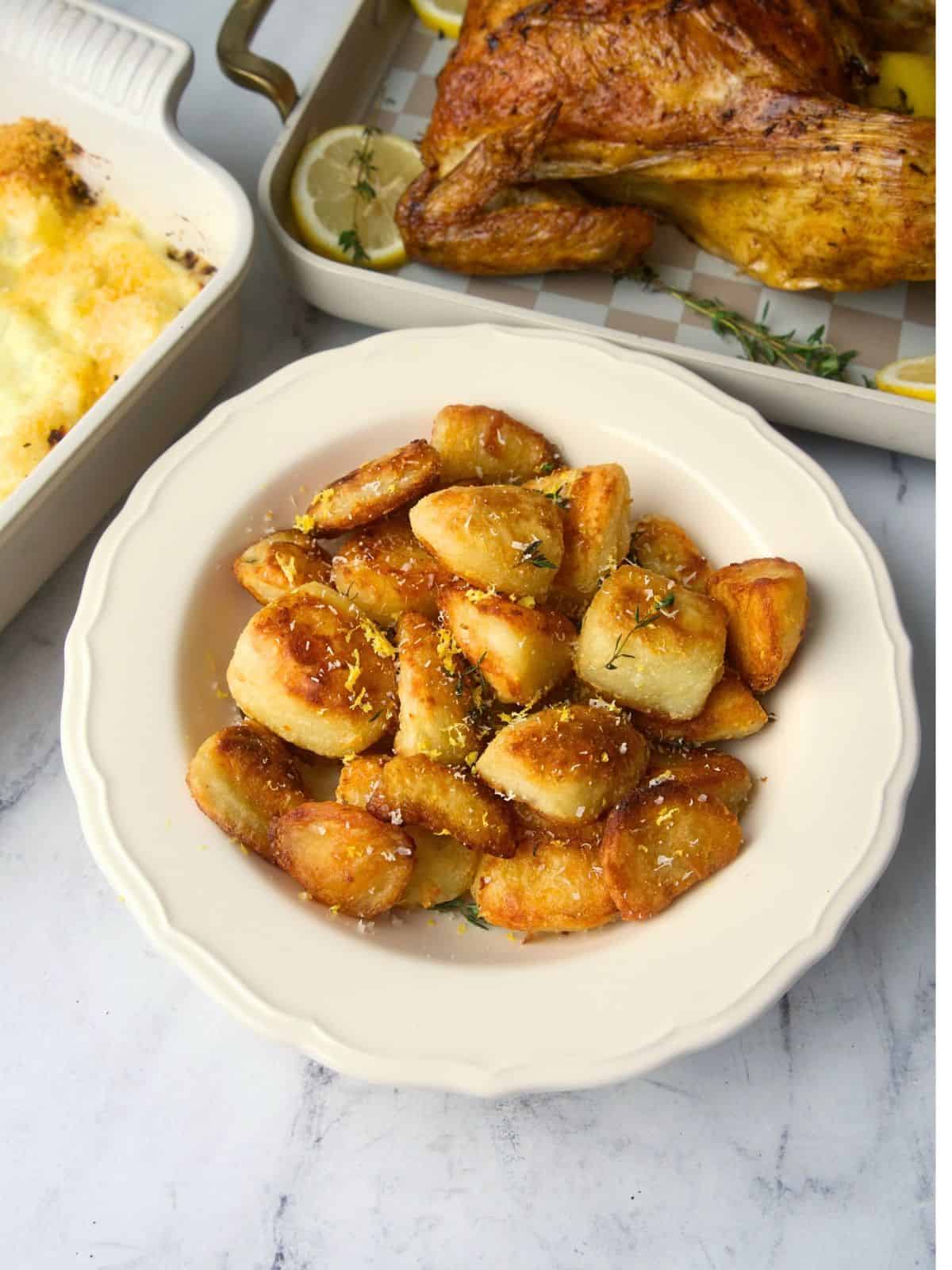
These goose fat roast potatoes are everything a roast potato should be: crunchy and golden on the outside, soft and fluffy in the middle. They're also make-ahead friendly, so you can parboil them the day before (or freeze them weeks ahead) and take a lot of the stress out of entertaining.
Crispy Goose Fat Roast Potatoes At A Glance
✅ Recipe Name: Crispy Goose Fat Roast Potatoes
🕒 Ready In: About 1 hour 15 minutes
👪 Serves: 4 as a side (easy to double for a crowd)
🍽 Nutrition: 422 calories, 5.1 grams protein, 3.8 grams fiber and 44.8 grams carbohydrates per serving
🥔 Main Ingredients: Floury potatoes, goose fat, cornstarch, sea salt flakes
📖 Dietary Info: Dairy-free and gluten-free as written (check your cornstarch label)
⭐ Why You'll Love It: Crunchy roasties with fluffy middles, and you can do most of the work the day before.
Roast potatoes are the part of a roast dinner everyone fights over, and in Ireland we take them very seriously. Whether it's a Sunday roast, Christmas or Thanksgiving, if you can make incredible roast potatoes, everyone will be impressed. They're always the star of the show.
This is the method I've tested and landed on. It takes a little more care than tossing chopped potatoes in oil, but every step is there for a reason, and the make-ahead options mean you're not stuck at the stove while everyone else is relaxing.
I've written this for cooks on both sides of the Atlantic, so you'll find Irish and UK potato varieties alongside their US equivalents, and both °C and °F throughout.
More Recipes You'll Love
If you love a crispy potato, you might also enjoy my oven baked sweet potato slices or my air fryer gnocchi with high-protein tzatziki dip. And if you're putting together a proper Irish spread, my easy no-knead Irish brown bread belongs on the table too.
Jump to:
- Crispy Goose Fat Roast Potatoes At A Glance
- More Recipes You'll Love
- Goose Fat Roast Potatoes Nutrition Highlights
- Key Ingredients & Substitutions
- Recipe Variations
- Equipment
- How To Make Goose Fat Roast Potatoes
- Expert Tips for Making Goose Fat Roast Potatoes
- Serving Suggestions
- How To Make Roast Potatoes Ahead of Time (Plus Storage Tips)
- Recipe FAQs
- 📖 Recipe
- 💬 Comments
Goose Fat Roast Potatoes Nutrition Highlights
I'll be honest: these are an indulgent side, and that's okay. Roast potatoes are part of a celebration meal, and enjoying them is part of the point. There's still more going on nutritionally than you might think.
- Potassium: Potatoes are a good source of potassium, a mineral that helps your body balance out sodium and plays a role in healthy blood pressure. If that's something you're working on, my guide on how to lower blood pressure naturally goes into more detail.
- Vitamin C and fiber: Potatoes also bring some vitamin C and fiber. Peeling removes some of the fiber, so roast potatoes aren't a high-fiber food, but pairing them with plenty of vegetables on the plate helps. Here's more on top fiber foods and how much you need.
- Goose fat: Goose fat is mostly unsaturated fat. Based on USDA data, a little over half of its fat is monounsaturated and roughly a quarter is saturated, compared with around half for butter. It still has more saturated fat than olive oil, which is why I keep goose fat potatoes for special occasions. If you'd like to know why the type of fat matters, read how changing your fats can help lower cholesterol.
- A small bonus for making ahead: Research suggests that cooking and then cooling potatoes increases their resistant starch, a type of carbohydrate that behaves more like fiber and feeds your gut bacteria. Some of it stays even after reheating, so parboiling the day before isn't just convenient.
- A quick note on the numbers: The nutrition info below counts all of the goose fat in the recipe, but some of it stays behind in the tray, so what you eat is likely a little lower.
Nutrition information was calculated using Cronometer, a nutrition tracking tool that uses the USDA FoodData Central database and verified brand data for accuracy. Estimates are based on the exact ingredients and amounts listed, so your numbers may vary slightly depending on the brands and measurements you use. Food is much more than just numbers though, so use these as a guide rather than a rule.
Key Ingredients & Substitutions
The complete ingredient list with measurements can be found in the recipe card below.
- Floury potatoes: The potato you pick makes a bigger difference than any trick in the method. Floury (starchy) potatoes have more starch and less water, so the outsides break down into a rough, fluffy layer that crisps up while the middles go soft and light. Waxy potatoes hold their shape and stay smooth, which is great in a potato salad but means they never get those craggy edges. If you're not sure, check the bag: anything labelled "floury" or "good for roasting and mashing" is a safe bet.
- Best potatoes for roasting: Rooster, Maris Piper, Kerr's Pink, Golden Wonder or King Edward in Ireland and the UK; russet (also sold as Idaho potatoes) in the US. Yukon Gold is creamier inside with a slightly less crunchy outside, and generic white potatoes can be hit or miss. Baby, new and salad potatoes (Queens, Charlotte, fingerlings) and red potatoes are best avoided here: they're lovely roasted whole with their skins on, but they won't give you classic fluffy roasties.
- Goose fat: This is what gives these potatoes their rich, savory flavor and deep golden crunch. You'll find jars in most UK and Irish supermarkets, especially around Christmas. Duck fat swaps in at the same amount and is often easier to find in the US. I haven't tested this exact recipe with olive oil, but regular or light olive oil (not extra virgin, which can smoke at this heat) is the swap I'd use for a lighter version.
- Cornstarch (cornflour in the UK and Ireland): A light dusting after parboiling gives the potatoes a thin, glassy, extra crunchy shell. Fine semolina is the classic roastie trick and gives a rougher, craggier crunch and a deeper golden color. Plain flour is the mildest option, with a softer crust that can turn doughy if you use too much. Arrowroot works much like cornstarch at the same amount but browns a little less.
- Baking soda (bicarbonate of soda): Just a little in the cooking water breaks down the outside of the potatoes a bit more, which means rougher edges and more crispy bits. Stick to the amount in the recipe, because too much can make the potatoes taste soapy.
- Sea salt flakes: Scattered over straight out of the oven, they add crunch and flavor. Fine salt works too, but use a little less.
A note on gluten-free: This recipe is gluten-free as written when you use cornstarch or arrowroot, but that isn't the same as guaranteed gluten-free. Cross-contact can happen during manufacturing, so check your brands for a "may contain" warning or choose certified gluten-free products if you're cooking for someone with coeliac disease.
Recipe Variations
- Lemon, Parmesan and thyme: This is how I like to finish them. Grate a little Parmesan over the potatoes straight out of the oven, then add some lemon zest and a few thyme leaves. Note this version contains dairy.
- Garlic and rosemary: Tucking 4 to 6 smashed garlic cloves (skin on) and a few sprigs of rosemary into the tray for the last 20 minutes also works great. You can then squeeze the soft garlic out of its skin to eat with the potatoes.
Equipment
- A large metal roasting tray: Metal heats up faster and browns better than glass or ceramic, which makes a real difference to the crunch. It needs to be big enough to hold the potatoes in a single layer.
- A colander: For draining and roughing up the potatoes.
How To Make Goose Fat Roast Potatoes
Below are the simple steps for how to make this recipe. Don't forget to check out the recipe card at the bottom for the full recipe.
- Heat the oven and tray. Put your roasting tray in the oven and heat it to 425°F or 220°C (200°C fan).
- Prep the potatoes. Peel them and cut into roughly 2in (5cm) chunks. Even sizes mean even cooking.
- Parboil. Cover the potatoes with cold water, add the salt and baking soda, and bring to a full rolling boil. Turn the heat down and simmer for 5 minutes, until the outsides are just softening but the middles are still firm.
- Heat the goose fat. While the potatoes simmer, add the goose fat to the hot tray and put it back in the oven so it gets really hot.
- Rough them up. Drain the potatoes in a colander and give it a few really good shakes, harder than feels right. You want a starchy, almost mashed layer on the outside, because that's what turns into the crunchy shell. Leave them to steam dry for about 10 minutes. Don't skip this: wet potatoes won't crisp.
- Coat. Sprinkle over the cornstarch and give another gentle shake so every piece is thinly coated.
- Into the fat. Carefully tip the potatoes into the hot fat (they should sizzle straight away) and turn them so they're coated all over. Spread them out in a single layer with space between them, because crowded potatoes steam instead of crisp.
- Roast. Roast for 15 minutes, turn, then roast for another 15 minutes and turn again. Give them a final 10 to 20 minutes, until deep golden and crisp. Uneven coloring is exactly what you want.
- Serve. Scatter with sea salt flakes and serve straight away.
Expert Tips for Making Goose Fat Roast Potatoes
- Have the fat hot before you drain. Time it so the tray is ready the moment the potatoes have steam dried. If the fat cools down, the potatoes soak it up instead of frying in it.
- Leave them alone for the first 15 minutes. If you turn them too early, the crust tears away and sticks to the tray. If a potato won't release when you turn it, give it a few more minutes and it will.
- Turn gently. Use a metal spatula or tongs and flip rather than stir, so you keep those crunchy edges intact.
- Go easy on the baking soda. ½ teaspoon is plenty for 1kg (2¼ lb) of potatoes.
- Add herbs and garlic late. Anything added at the start will burn and turn bitter by the time the potatoes are done.
- Salt straight out of the oven. Flaky salt sticks best while the fat is still glistening.
Serving Suggestions
- The classic roast dinner: with roast chicken, turkey or beef and plenty of gravy.
- Christmas or Thanksgiving: alongside Brussels sprouts, honey-roasted carrots and parsnips, and all the trimmings.
- A Sunday roast for two: halve the recipe and use a smaller tray.
- A weeknight treat: they're lovely with my healthy marry me chicken, which has plenty of sauce for the potatoes to soak up.
- Finish with something sweet: follow the feast with my Baileys cheesecake or a traditional apple pie.
How To Make Roast Potatoes Ahead of Time (Plus Storage Tips)
Can you make roasted potatoes ahead of time? Yes, and honestly, it's the best way to do it when you're cooking a big meal.
- Peel the day before: Keep peeled raw potatoes covered in cold water in the fridge so they don't brown. They'll be fine for up to 24 hours.
- Parboil the day before: Parboil, drain and rough them up as in the recipe, then let them cool within an hour or two and refrigerate for up to 24 hours. Store them dry, not in water. If you can, leave them uncovered in the fridge: the surface dries out even more, so they actually crisp better than freshly boiled ones. On the day, coat and roast as normal, allowing an extra 5 to 10 minutes.
- Freeze weeks ahead: Spread the parboiled, fluffed potatoes on a tray and freeze until solid, then move them to a freezer bag for up to 3 months. Roast from frozen in hot fat and add about 10 to 15 minutes.
- Leftovers: Keep cooled roast potatoes in an airtight container in the fridge for up to 3 days.
- Reheat: Spread them on a tray and reheat at 400°F or 200°C (180°C fan) for 10 to 15 minutes, until hot and crisp again. They lose a little of their crunch, so if you have the choice, parboiling ahead gives a better result than roasting fully and reheating.
Making Roast Potatoes for a Crowd
This recipe serves 4, but it scales up easily for a holiday table. For 8 people, double everything and use two large metal trays rather than piling everything onto one. Swap the trays between the top and bottom shelves each time you turn the potatoes, and allow an extra 5 to 10 minutes. A fan oven gives the most even result when you're roasting on two shelves.
Recipe FAQs
In Ireland and the UK, most big supermarkets sell jars of goose fat, and they're easiest to find in the run-up to Christmas. In the US, look in specialty food shops, butchers or online. If you can't find it, duck fat works the same way.
Yes. Let the fat cool slightly, strain it through a fine sieve into a clean jar, and keep it in the fridge. It's great for your next batch of roast potatoes or for roasting vegetables. Throw it out if it smells off or has picked up a burnt taste.
No, but peeling gives you the classic result. The fluffy, craggy crust comes from the starchy outside of the potato breaking down, and skin gets in the way of that. Skin-on roast potatoes are still tasty (and keep a little more fiber), they'll just be less crunchy.
You can, but they crisp best at a high heat, which most roasts don't cook at. The easiest way is to put the potatoes in once the meat comes out to rest. Turkey and large joints need a good rest anyway, which gives the potatoes time to finish at full temperature.
📖 Recipe
Crispy Goose Fat Roast Potatoes
Equipment
- Large metal roasting tray
- Colander
Ingredients
- 1 kilogram floury potatoes 2¼ pounds, such as Maris Piper, Rooster or russet
- 1 tablespoon salt for the cooking water (table salt or Morton kosher salt)
- ½ teaspoon baking soda bicarbonate of soda
- 100 grams goose fat 7 tablespoons
- 2 teaspoons cornstarch cornflour in the UK and Ireland
- sea salt flakes to serve
Optional
- 4 to 6 garlic cloves smashed, skin on
- 3 to 4 sprigs rosemary or thyme
- 1 lemon zested
- 20 grams Parmesan ¼ cup, finely grated
- 1 tablespoon chopped fresh parsley or fresh thyme leaves
Instructions
- Put a large metal roasting tray in the oven and preheat to 425°F or 220°C (200°C fan).
- Peel the potatoes and cut them into roughly 2 inch or 5 centimeter chunks, keeping the pieces as even in size as possible.1 kilogram floury potatoes
- Put the potatoes in a large pan, cover with cold water and stir in the salt and baking soda. Bring to a full rolling boil, then reduce the heat and simmer uncovered for 5 minutes, until the outsides are just softening but the middles are still firm.1 tablespoon salt, ½ teaspoon baking soda
- While the potatoes simmer, add the goose fat to the hot tray and return it to the oven for a few minutes until the fat is very hot.100 grams goose fat
- Drain the potatoes in a colander and shake firmly a few times to rough up the edges. Leave to steam dry for about 10 minutes.
- Sprinkle over the cornstarch and shake gently so every piece is thinly coated.2 teaspoons cornstarch
- Carefully tip the potatoes into the hot fat, turning them so they are coated all over. Spread them out in a single layer with space between each piece.
- Roast for 15 minutes, then turn. Roast for another 15 minutes and turn again, adding the garlic and herbs now if using. Roast for a final 10 to 20 minutes, until deep golden and crisp.4 to 6 garlic cloves, 3 to 4 sprigs rosemary or thyme
- Season with sea salt flakes to taste as soon as they come out of the oven. Finish with Parmesan, lemon zest and thyme or parsley if using, and serve straight away.sea salt flakes, 1 lemon, 20 grams Parmesan, 1 tablespoon chopped fresh parsley or fresh thyme leaves
Save This Recipe! 💌
Maria's Notes
Use floury potatoes (Maris Piper, Rooster, King Edward or russet). Waxy potatoes won't go fluffy and crisp.
Don't skip the steam dry. Wet potatoes won't crisp.
Keep to ½ teaspoon baking soda. More can make the potatoes taste soapy.
Don't crowd the tray. Use two trays if needed. Make ahead
Peel: keep peeled raw potatoes covered in cold water in the fridge for up to 24 hours.
Parboil: complete steps 2, 3 and 5, cool within 1 to 2 hours and refrigerate, ideally uncovered, for up to 24 hours. Coat and roast as normal, adding 5 to 10 minutes. Storage
Fridge: cooled leftovers in an airtight container for up to 3 days.
Freezer: freeze parboiled potatoes rather than fully roasted ones for the best texture.
Reheat: spread on a tray at 400°F or 200°C (180°C fan) for 10 to 15 minutes until hot and crisp. For a crowd
Double the recipe for 8 and use two large metal trays. Swap the trays between shelves each time you turn the potatoes and allow an extra 5 to 10 minutes. Substitutions
Duck fat swaps in 1:1 for goose fat. Fine semolina, plain flour or arrowroot can replace the cornstarch at the same amount (semolina and flour contain wheat). Gluten-free
This recipe is gluten-free as written with cornstarch or arrowroot, but that is not the same as guaranteed gluten-free. Cross-contact can happen during manufacturing, so check your brands or choose certified gluten-free products. Nutrition
Calculated in Cronometer for 4 servings using raw potato flesh (1000 grams), goose fat (100 grams) and cornstarch (5 grams). Includes all of the goose fat, although some stays in the tray. Salt and baking soda in the cooking water, sea salt flakes and optional extras are not included.
Comments
No Comments