

If you’ve been told your cholesterol is a little high, your first thought might be to cut out all fat. But, it’s not about eating less fat, it’s about eating better fat. In fact, the right kinds of fat can actually help lower cholesterol naturally and support your heart health.
In this post, I’ll walk you through the easiest fat swaps you can make, why they matter, and how to enjoy them in everyday foods.
Please note: This article is not intended to provide medical advice, diagnosis, opinion, treatment or services. This article and the links contained in it provide general information for educational purposes only. The information provided in this article is not a substitute for medical care, and should not be used in place of the advice of your physician or registered dietitian.
There are plenty of dietary changes that can help lower cholesterol. But often people get carried away at the start and try to make too many changes at once. The result? They only stick with them for a short time.
So today we’re keeping it simple and looking at just one thing: fat. The type of fat you eat makes a big difference to your cholesterol, and a few small swaps can go a long way.
TL;DR:
- The biggest driver of high cholesterol in the diet is saturated fat, not cholesterol from food.
- Trans fats are harmful and should be avoided.
- Unsaturated fats like olive oil, avocado, nuts, seeds, and oily fish support heart health by lowering LDL and raising HDL.
- Aim for two servings of fish each week, with at least one being oily fish such as salmon, sardines, mackerel, or trout.
- Simple swaps matter: use olive oil instead of butter, snack on nuts instead of pastries, and choose lean meats or legumes over fatty cuts.
- Adding more fiber-rich foods such as beans, fruits, vegetables, and whole grains also helps crowd out saturated fat and lower cholesterol naturally.
Jump to:
- TL;DR:
- What Is Cholesterol and Why Does It Matter
- How to Lower Cholesterol Naturally – Watch the YouTube Lesson
- Dietary Fat and Cholesterol
- The Fats To Limit
- What About The Saturated Fat From Dairy?
- The Fats To Eat More Of
- Unsaturated Fat
- Omega-3s
- Top Tips to Lower Saturated Fat in Your Diet
- Want To Learn More About Cholesterol?
- Cholesterol Friendly Recipes
- FAQS
- 💬 Comments
What Is Cholesterol and Why Does It Matter
Cholesterol is a type of fat in our blood. Some of it is produced in the liver and some comes from the food that we eat. Our bodies need a certain amount of cholesterol for normal cell function, to help digestion and produce certain hormones. So not all cholesterol is bad.
If your total cholesterol is high, it can mean that you have a lot of LDL (bad) cholesterol in your blood. Too much LDL cholesterol can be harmful because it sticks to the inside walls of your arteries. This can lead to fatty material building up (a process called atherosclerosis). This makes it harder for blood to flow through, which can lead to a stroke or heart attack.
If you need help understanding your cholesterol levels, make sure to check out my post on this topic.
Save This Recipe! 💌
How to Lower Cholesterol Naturally – Watch the YouTube Lesson
Prefer learning by watching instead of reading? Check out my YouTube video on how to lower cholesterol naturally. In it, I walk you through the role of fats, the best swaps to make, and the simple habits that really work.
Dietary Fat and Cholesterol
When it comes to cholesterol, not all fats act the same way in your body. Some types of fat can raise your LDL (often called the “bad” cholesterol), while others can help lower it and even support higher levels of HDL (the “good” cholesterol that helps clear excess cholesterol from your blood).
- Trans fats are the worst offenders. They’re mostly found in processed baked goods, fried foods, and some margarines. These not only raise LDL but also lower HDL.
- Saturated fats are found in foods like butter, fatty cuts of meat, cream, cheese, and pastries. Eating too much of these can raise LDL cholesterol.
- Unsaturated fats are your heart-friendly fats. These come from foods like olive oil, avocados, nuts, seeds, and oily fish. They help improve your cholesterol profile by lowering LDL and supporting HDL.
The key message? You don’t need to avoid fat altogether. Instead, focus on the type of fat you’re eating and make simple swaps that favor unsaturated fats over saturated and trans fats
The Fats To Limit
As mentioned above, trans fats and saturated fat are the main types of fat that can raise LDL (“bad”) cholesterol, so it’s important to keep them to a minimum in your diet.
The American Heart Association recommends limiting saturated fat to less than 6% of daily calories and avoiding trans fats.
Trans Fats
Trans fats are created by hydrogenating (adding hydrogen) to vegetable oil. This process makes them more solid and extends the shelf life of products.
These fats are harmful because they both raise LDL and lower HDL (“good”) cholesterol.
You’ll find trans fats mainly in:
- Fried foods such as donuts, pizza, and French fries
- Some processed and packaged baked goods
- Margarines and shortenings
In Europe, trans fats are restricted in packaged foods, but they can still be found in fried foods and some imported products. In the U.S., partially hydrogenated oils (the main source of trans fats) have been phased out, but small amounts may still appear in certain processed foods.
Saturated Fat
Saturated fat is another type of fat that can raise LDL (“bad”) cholesterol when eaten in excess. Unlike trans fats, small amounts of saturated fat can fit into a healthy diet, but most of us are eating much more than we need.
We get saturated fat in our diet from:
- Eating out and takeaways (often cooked in butter, cream, or oils high in saturated fat)
- Processed and packaged foods
- Non-lean meats such as beef, pork, and lamb
- Poultry skin
- Visible fat on meat
- Cakes, biscuits, and pastries
- Butter and cream
- Tropical oils such as coconut oil and palm oil
What About The Saturated Fat From Dairy?
Dairy foods like milk, yogurt, and cheese naturally contain saturated fat, and for years it was assumed this made them harmful for heart health. However, newer research shows the picture is more complex.
Dairy products provide nutrients such as calcium, potassium, and phosphorus, which may have a protective effect on the heart. Because of this, the impact of dairy on cholesterol and cardiovascular risk appears to be more neutral than once thought.
Most nutrition guidelines still advise choosing low-fat or reduced-fat dairy, but current evidence suggests that moderate amounts of regular dairy can also be part of a balanced diet.
If you want to learn more about dairy and how it can fit into your diet, check out my YouTube video below.
The Fats To Eat More Of
We know that cutting back on saturated fat can help improve cholesterol levels. But what you replace it with is just as important. Swapping butter for added sugar will not do your heart any favors. The real key is to bring in the right kinds of fat, and this is where heart-healthy unsaturated fats come in.
If you look at some of the healthiest populations in the world, such as those in the Blue Zones or the Mediterranean, you will notice they eat plenty of fat. The difference is that most of it comes from unsaturated, heart-friendly sources.
Examples of these include:
- avocados
- olives
- olive oil
- tapenade
- rapeseed oil
- pesto
- hummus
- nuts & seeds
- oily fish
Unsaturated Fat
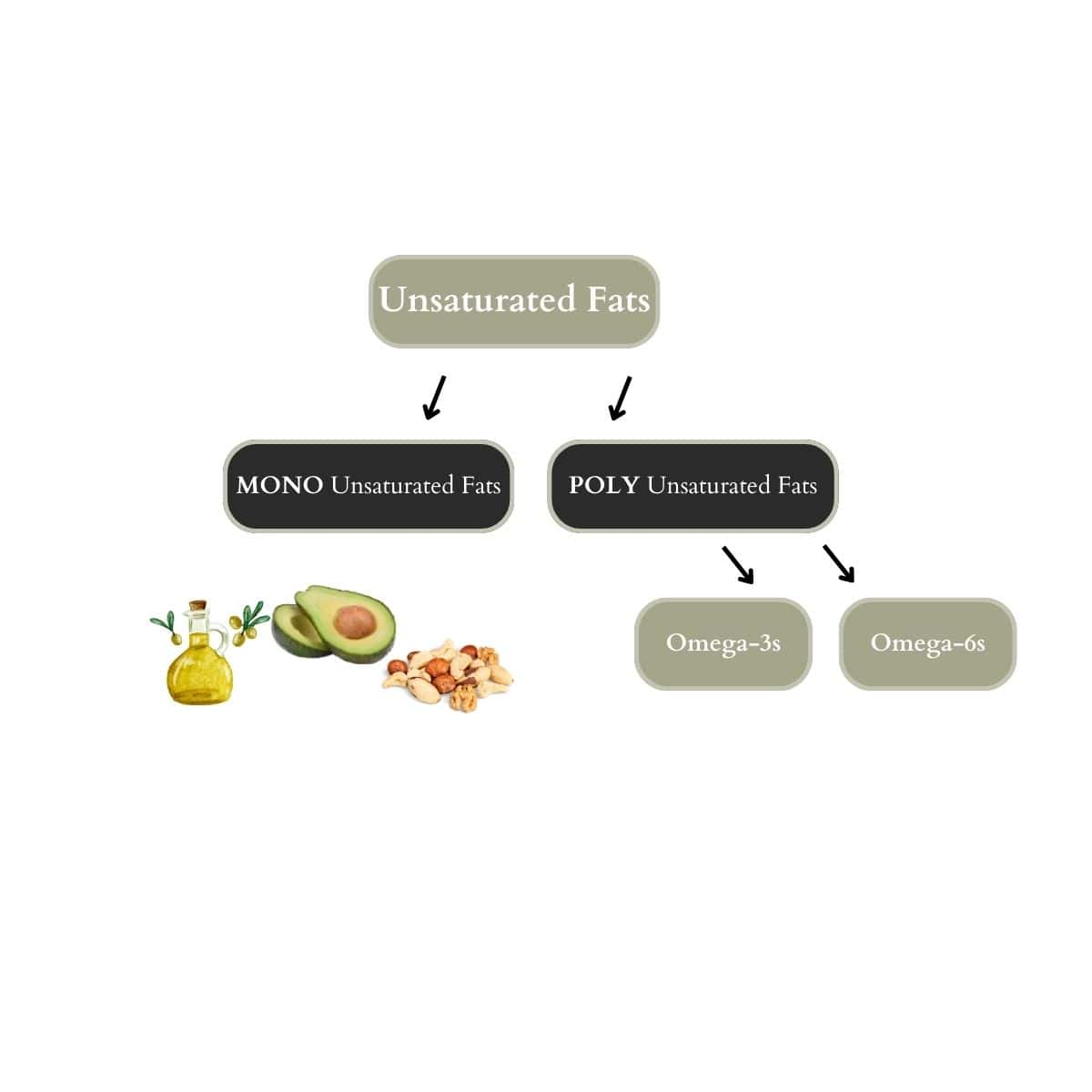
Unsaturated fats are further broken down into monounsaturated and polyunsaturated fats.
Monounsaturated fats are found in olive oils, avocados and tree nuts; we should include a source of these daily.
Polyunsaturated fat is further broken down into omega 3s and omega 6s.
Omega-3s
I want to draw your attention in particular to omega-3 fatty acids because they can:
- Increase our good HDL cholesterol.
- Reduce the bad LDL cholesterol
- Lower inflammation
So it's a win, win, win situation!
We primarily get omega-3 three fats from oily fish. Oily fish are usually colored fish, so think salmon, mackerel, trout, sardines and herring.
Aim for two servings of fish each week, with at least one being oily fish. Try my 15 minute salmon rice bowl recipe to help you get started.
Can I Take An Omega-3 Supplement?
This is a very valid question as many people do not like fish or don't eat it very often. There has been a lot of research into omega-3 supplements and heart health. Unfortunately, though, the evidence shows that the benefit comes from the fish.
If your fish intake is poor, I do recommend to clients that there is no harm in taking an omega-3 supplement, but eating fish is the ideal option.
What About Plant Sources Of Omega-3s?
We can get some omega-3 fats in plant-based foods (chia seeds, walnuts and flaxseeds), but it's important to say that the plant-based Omega-3 is a different type of Omega-3 three to the one in oily fish. So, in oily fish, we get DHA and EPA, and they're the ones that have all the heart-healthy benefits. In our plant-based sources of Omega-3, we have a different type of Omega-3 called ALA, which doesn't have the same benefits. If you can include the oily fish once or twice a week, that is ideal.
Vegan Sources Of Omega-3
If you are a vegan, you can still get these beneficial omega 3s from a supplement. But make sure you are choosing a supplement sourced from Algae, as this will have the EPA and DHA we are looking out for. Do not choose an omega-3 supplement from flaxseeds.
Top Tips to Lower Saturated Fat in Your Diet
- Avoid eating out frequently, as restaurant meals often contain high levels of unhealthy ingredients.
- Minimise the consumption of processed and packaged foods, as they tend to be high in additives, preservatives, and unhealthy fats.
- Limit the intake of non-lean meats like beef, pork, and lamb, as they are typically higher in saturated fats.
- Remove the skin from poultry before consuming, as it contains a significant amount of fat.
- Trim the visible fat from meat to reduce the amount of unhealthy fats in your meal.
- Reduce the consumption of cakes, biscuits, and pastries, as they are usually high in sugar, unhealthy fats, and refined carbohydrates.
- Use butter and cream sparingly, as they are rich in saturated fats that can contribute to cardiovascular health issues.
- Limit the use of tropical oils like coconut oil, as they are high in saturated fats and may affect your cholesterol levels.
Instead of only focusing on reducing saturated fat, we can also think about what we can add in to our diet. Eating more fiber-rich foods like beans, whole grains, fruits, and vegetables naturally crowds out foods higher in saturated fat. You can read more about how much fiber you should eat here.
Want To Learn More About Cholesterol?
Check out my other cholesterol related posts below.



Cholesterol Friendly Recipes
Inspired to get in the kitchen and take control of your health? Try out any of my dietitian-approved recipes below. There are plenty to explore!


FAQS
For most people, eggs don’t significantly raise cholesterol. They can be part of a balanced diet, especially when paired with vegetables and whole grains
Coconut oil is high in saturated fat. While it’s often marketed as a “superfood,” research shows it raises LDL cholesterol. It’s best used sparingl
You may start to see changes in as little as 4–6 weeks after making consistent changes, but bigger improvements are usually seen over 3 months or more

Comments
No Comments