

Calories do matter. I know that is not always the answer people want to hear, but it is true. If weight loss is the goal, your body does need to use more energy than it takes in over time.
But...calorie counting is not nearly as accurate as people think.
As a dietitian, I have seen calorie counting help some people become more aware of what they are eating. But I have also seen it make people anxious, obsessive and disconnected from their own hunger cues.
So in this article, I want to explain calorie counting properly.
Jump to:
- TL;DR
- What is Calorie Counting?
- Do Calories Matter?
- Calorie Counting As A First Step
- Why Calorie Counting is Often Inaccurate
- When Calorie Counting Can Be Helpful
- When I Would Avoid Calorie Counting
- What to focus on instead of calories
- So, Should You Count Calories?
- My Dietitian Approach
- Final thoughts
- References
- 💬 Comments
TL;DR
- Calories matter, but calorie counting is not a perfect science.
- Food labels, apps and restaurant menus are estimates, not exact numbers.
- Your body does not absorb every calorie from every food in the exact same way.
- Whole foods and highly processed foods can behave differently in the body.
- Calorie counting can be helpful for some people, but it can also worsen your relationship with food.
- For most women, I prefer starting with meal structure, protein, fiber, calcium, fruit, vegetables and consistency before tracking calories.
What is Calorie Counting?
Calorie counting means tracking the amount of energy you eat and drink each day.
Usually, this involves using a food tracking app and logging your meals, snacks, drinks, cooking oils, sauces and portion sizes.
In theory, it sounds simple.
You set a calorie target, eat within that target and lose weight.
But in real life, it is much more complicated than that.
Your body is not a calculator. Food is not just a number. And most calorie numbers are not as precise as they look.
Do Calories Matter?
Yes, calories matter.
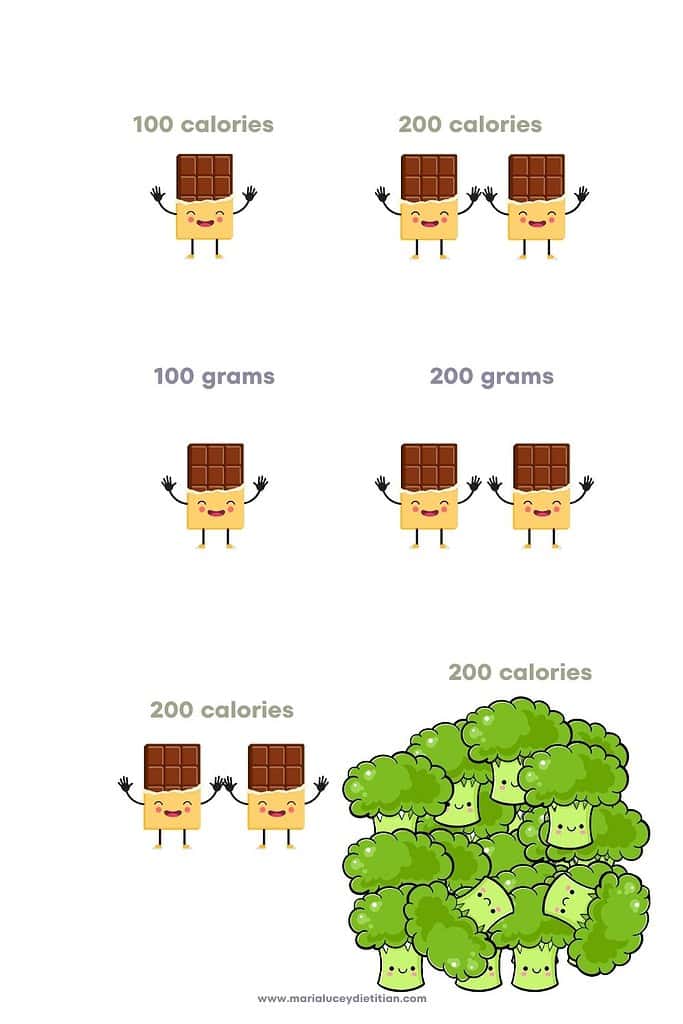
For example, 200 calories of chocolate contains more energy than 100 calories of chocolate.
That part is simple.
But would I compare 200 calories of chocolate to 200 calories of broccoli and pretend they are the same thing nutritionally?
Absolutely not.
The chocolate and broccoli may contain the same amount of energy on paper, but they do very different things for your body.
Broccoli provides fiber, water, vitamins, minerals and volume. Chocolate provides energy, sugar and fat, and can absolutely be part of your diet, but it is not going to fill you up in the same way.
This is why “a calorie is a calorie” is technically true in one sense, but very misleading in real life.
Calories matter, but so does food quality, protein, fiber, volume, satisfaction, digestion, hormones, appetite, blood sugar and your relationship with food.
Calorie Counting As A First Step
The main reason I do not routinely recommend calorie counting is because it can quickly damage a person’s relationship with food.
Food is not just fuel. It is also culture, connection, pleasure, comfort, celebration and nourishment.
When every meal becomes a math equation, it can take the joy out of eating very quickly.
Some people can track calories neutrally and move on with their day. Others cannot.
For some people, calorie counting can lead to anxiety, guilt, rigid food rules, compensating for meals, ignoring hunger, or feeling like they have “failed” because they went over a number in an app.
There is research showing that diet and fitness apps can trigger or worsen disordered eating behaviors for some users, particularly when the focus becomes excessive tracking, rigid targets or constant quantification
Another study looking at MyFitnessPal use in an eating disorder population found that many participants felt the app contributed to their eating disorder symptoms.
That does not mean calorie tracking is automatically bad for everyone.
But it does mean we need to be careful.
If you have a history of an eating disorder, disordered eating, obsessive tracking, severe food anxiety or feeling out of control around food, I would not recommend calorie counting without support from a qualified professional.
Why Calorie Counting is Often Inaccurate
Even if you have a healthy relationship with food, calorie counting still has major limitations.
Here are the biggest reasons.
1. Calories on labels are estimates
Most people assume the calorie number on a food label is exact.
It is not.
Calories are usually estimated using a system called the Atwater system. This is where foods are estimated based on the average calories provided by protein, carbohydrate, fat and alcohol.
In simple terms:
- Protein provides around 4 calories per gram
- Carbohydrate provides around 4 calories per gram
- Fat provides around 9 calories per gram
- Alcohol provides around 7 calories per gram
These values are useful, but they are still averages. They do not perfectly account for every food, every food structure, every person’s digestion or how much energy your body actually absorbs from that food.
There is also normal variation in food products.
In the US, FDA regulations state that foods with calories, sugars, total fat, saturated fat, cholesterol or sodium can be considered misbranded if the measured value is more than 20 percent higher than the value declared on the label.
In plain English, food labels are helpful, but they are not perfect.
A label that says 200 calories should be treated as a useful estimate, not an exact measurement.
2. Your body uses energy to digest food
When you eat food, your body has to digest, absorb, transport and metabolize it.
That process uses energy.
This is called diet-induced thermogenesis, or the thermic effect of food.
Protein takes the most energy to digest and metabolize. Carbohydrates are next. Fat generally takes the least.
A review on diet-induced thermogenesis found that a mixed diet typically results in diet-induced energy expenditure of about 5 to 15 percent of daily energy expenditure.
This is one reason why 500 calories from a high-protein meal does not behave exactly the same way as 500 calories from a very low-protein, highly processed snack.
The number may look the same in an app, but your body still has to do different amounts of work.
Save This Recipe! 💌
3. You do not absorb all calories from all foods equally
This is one of my favorite examples because it makes the whole thing easier to understand.
Think about sweetcorn.
Have you ever eaten corn on the cob or sweetcorn in a salad and then later noticed it in your stool?
A little gross, yes. But also a very useful nutrition lesson.
If a food label says a portion of sweetcorn contains 100 calories, but some of that sweetcorn passes through your digestive system only partly broken down, did your body actually absorb all 100 calories?
Probably not.
This is called calorie availability.
The calories listed on paper are not always the same as the calories your body can actually access.
Food structure matters.
A whole almond, for example, is not absorbed in the exact same way as almond butter or almond flour. When food is ground, blended, chopped or cooked, some of that work is already done for your digestive system.
That can make the calories more available.
4. Nuts are a great example of calorie availability
Nuts are often called “high calorie,” and technically, yes, they are energy dense.
But they are also a brilliant example of why calorie counting is not as simple as it looks.
A serving of almonds was traditionally estimated to provide around 168 to 170 calories using standard Atwater factors.
But research from the USDA found that the metabolizable energy of almonds was closer to 129 calories per 28 gram serving. In other words, the standard calculation overestimated the calories by around 32 percent.
This does not mean almonds are “free calories.”
Please do not take that message from this.
It simply means that your body does not necessarily absorb every calorie from every food in the exact way a label or app suggests.
5. Whole foods and processed foods can behave differently
Food processing can change how available calories are to your body.
When you chop, blend, cook, grind or process food, you are partly breaking it down before it even reaches your digestive system.
This can make it easier and quicker for your body to digest and absorb.
One small study compared two meals with the same calories and similar macronutrients. One meal was made from more whole foods, while the other was made from more processed foods. The study found that post-meal energy expenditure was nearly 50 percent lower after the processed meal compared with the whole-food meal.
That does not mean processed foods are “bad” and whole foods are “good.”
I do not like talking about food that way.
But it does mean food form matters.
An apple, applesauce and apple juice are not the same experience for your body.
The apple takes longer to chew, provides more fiber and tends to be more filling.
Applesauce is easier to eat quickly.
Apple juice is even easier to drink quickly and does not provide the same fullness as eating the whole fruit.
Same fruit. Very different effect.
6. Calorie tracking apps are only as accurate as the information entered
Even if the label were perfectly accurate, which it is not, there is another issue.
Human error.
Most people are not weighing every gram of food.
And even when they are, there are still challenges:
- The database entry may be wrong
- The portion size may be guessed
- Cooking oils may be missed
- Sauces, dressings and bites may not be logged
- Restaurant meals can vary a lot
- Homemade recipes can be hard to track accurately
- Different brands can have different values
- The same food can weigh differently cooked versus raw
This is why I always say calorie tracking is an estimate of an estimate.
It can still be useful for awareness, but it should not be treated like a perfect number.
When Calorie Counting Can Be Helpful
Even though I do not recommend calorie counting as a first step for most people, I am not completely against it.
There are situations where it can be useful.
Calorie counting may help if:
- You have no history of disordered eating
- You can track without becoming obsessive
- You are using it short term for awareness
- You are working toward a specific performance or body composition goal
- You are working with a dietitian or qualified professional
- You find it genuinely helpful and not stressful
Sometimes, tracking for a few days can help people spot patterns.
For example, you may realize your “healthy salad” is not very filling because it has almost no protein.
Or you may realize your coffee order is adding more sugar and calories than you thought.
Or you may notice that you are skipping breakfast, grazing all afternoon and then feeling out of control at night.
That information can be helpful.
But you do not always need calorie counting to find those patterns.
A food diary, meal photos, hunger ratings, or simply looking at your meal structure can often give you enough information without needing to track every number.
When I Would Avoid Calorie Counting
I would be very cautious with calorie counting if:
- You have a history of an eating disorder
- You feel anxious when you do not know the calories in a meal
- You ignore hunger to stay under a number
- You feel like you have “failed” when you go over your target
- You avoid social situations because of tracking
- You compensate with restriction or exercise after eating
- You become preoccupied with food, weight or numbers
- You feel your mood depends on whether you stayed within your target
If that sounds familiar, calorie counting is probably not the right tool for you right now.
That does not mean you cannot improve your health or change your body composition.
It just means you may need a different approach.
What to focus on instead of calories
For most women, I would rather start with the foundations.
These are the things I look at before calories.
1. Eat three intentional meals
This sounds simple, but it changes everything.
Many women do not need a more complicated diet plan.
They need breakfast, lunch and dinner that actually keep them full.
Grazing all day often feels like eating less, but it can leave you undernourished, low in protein, low in fiber and constantly thinking about food.
Start with structure.
Three meals. Enough food. No chaos.
2. Build meals around protein
Protein supports fullness, muscle maintenance and healthy body composition.
You do not need to eat like a bodybuilder, but most women feel much better when they include a clear protein source at meals.
Examples include:
- Greek yogurt
- Eggs
- Chicken
- Turkey
- Fish
- Tofu
- Tempeh
- Lentils
- Beans
- Cottage cheese
- Lean beef
- Edamame
Instead of asking, “How many calories is this?” try asking, “Where is the protein?”
I have lots of high protein recipe ideas to help you get started.
3. Add fiber-rich carbohydrates
Carbs are not the enemy.
But the type of carb and the portion can make a big difference to your energy, hunger and blood sugar.
Fiber-rich carbohydrates include:
- Oats
- Potatoes
- Sweet potatoes
- Beans
- Lentils
- Whole grain bread
- Brown rice
- Quinoa
- Fruit
- Vegetables
Fiber helps meals feel more satisfying and supports gut health.
A 400 calorie meal with protein and fiber will usually feel very different from a 400 calorie snack that is mostly refined carbs and fat. Learn more about the top fiber foods here.
4. Eat more fruit and vegetables
Not because they are low calorie.
Because they add volume, fiber, micronutrients and color to your diet.
This is one of the simplest ways to make your meals more filling without needing to micromanage every calorie.
Aim to add fruit or vegetables to most meals.
Not perfectly. Just consistently.
5. Pay attention to calcium
This is especially important for women.
So many women are focused on calories, protein and weight loss that they forget about bone health.
Calcium matters for your long-term health, especially as you move through your 30s, 40s, 50s and beyond.
Instead of only counting calories, I would love more women to ask:
“Am I getting enough calcium most days?”
That might look like dairy, fortified plant milks, calcium-set tofu, canned fish with bones, yogurt, skyr, cheese, or other calcium-rich foods.
6. Look at your evening routine
A lot of people do fairly well during the day and then struggle in the evening.
That does not always mean they lack willpower.
Sometimes it means they did not eat enough earlier.
Sometimes it means they are tired.
Sometimes it means they are using food to decompress.
Sometimes it means their meals are not satisfying enough.
Before cutting calories lower, look at the pattern.
- Are you eating enough at breakfast and lunch?
- Are your meals satisfying?
- Are you constantly snacking after dinner?
- Would a “kitchen closed” routine after dinner help?
Often, the solution is not more tracking. It is better structure.
So, Should You Count Calories?
Maybe.
But it would not be my first recommendation for most women.
Calories matter, but calorie counting is an imperfect tool.
It can be inaccurate. It can be time-consuming. It can become stressful. And for some people, it can damage their relationship with food.
If you are going to use calorie counting, I would use it as a short-term awareness tool, not a life sentence.
And I would never let a calorie app overrule your common sense, hunger cues, health goals or quality of life.
My Dietitian Approach
My approach is not “ignore calories forever.”
My approach is:
Start with the big rocks.
Before counting every calorie, ask yourself:
- Am I eating regular meals?
- Am I getting enough protein?
- Am I getting enough fiber?
- Am I eating fruit and vegetables most days?
- Am I getting enough calcium?
- Am I sleeping enough?
- Am I moving my body?
- Am I eating in a way I can actually maintain?
If those things are not in place, calorie counting usually becomes a distraction.
You end up obsessing over numbers while missing the habits that actually make healthy eating easier.
Final thoughts
Calorie counting can work for some people.
But it is not the only way to lose weight, and it is definitely not the best approach for everyone.
Calories matter, but your body is more complicated than an app.
Food labels are estimates. Digestion takes energy. Food structure matters. Your body does not absorb every calorie from every food equally. And your relationship with food matters too.
So before you download another tracking app, start here:
Eat three balanced meals.
Include protein.
Add fiber.
Eat enough.
Support your bones.
Build consistency.
That is the foundation.
And for most women, it is a much better place to start.
References
- Westerterp KR. Diet induced thermogenesis. Nutrition & Metabolism, 2004
- USDA Agricultural Research Service. An improved method to estimate calories. USDA ARS, 2013
- USDA. Going nuts for calories. USDA, 2018
- Novotny JA et al. Discrepancy between the Atwater factor predicted and empirically measured energy values of almonds in human diets. American Journal of Clinical Nutrition, 2012
- Barr SB and Wright JC. Postprandial energy expenditure in whole-food and processed-food meals. Food & Nutrition Research, 2010
- US Food and Drug Administration. Nutrition labeling of food. 21 CFR 101.9
- Eikey EV et al. Effects of diet and fitness apps on eating disorder behaviors. Journal of Medical Internet Research, 2021
- Levinson CA et al. My Fitness Pal calorie tracker usage in the eating disorders. Eating Behaviors, 2017

NutrifyMe says
I agree that calorie tracking can be useful for some people, but it shouldn't become an obsession. Learning to understand hunger, portions and food quality can also be valuable. A flexible approach can make weight loss without dieting feel much more realistic and sustainable.
Maria Lucey RD says
Absolutely! Calorie tracking can be a really useful tool, but it definitely doesn’t need to be something you do forever. Building awareness around hunger, portions and overall food quality can make things feel much more flexible and sustainable long term 😊
NutrifyMe says
I really liked the point about calorie counting not being as simple as it seems. I think understanding hunger, portions and food choices is just as important as focusing on numbers. A flexible approach makes healthy eating much easier to maintain.
Maria Lucey RD says
Absolutely — the numbers can be helpful, but they’re only one part of the picture. Learning to notice hunger, portions and the types of foods that keep you satisfied can make healthy eating feel much more sustainable 😊